Smart Farming IoT: Hybrid LoRa
An AgriTech sensor network for smart agriculture, built on battery-powered nodes that monitor soil moisture, NPK, pH, EC, and temperature in real time. Nodes connect via a hybrid LoRa (combining LoRaWAN & LoRa mesh) - extending reliable coverage well beyond the range of a single gateway, even across large, irregular, or obstructed field layouts.
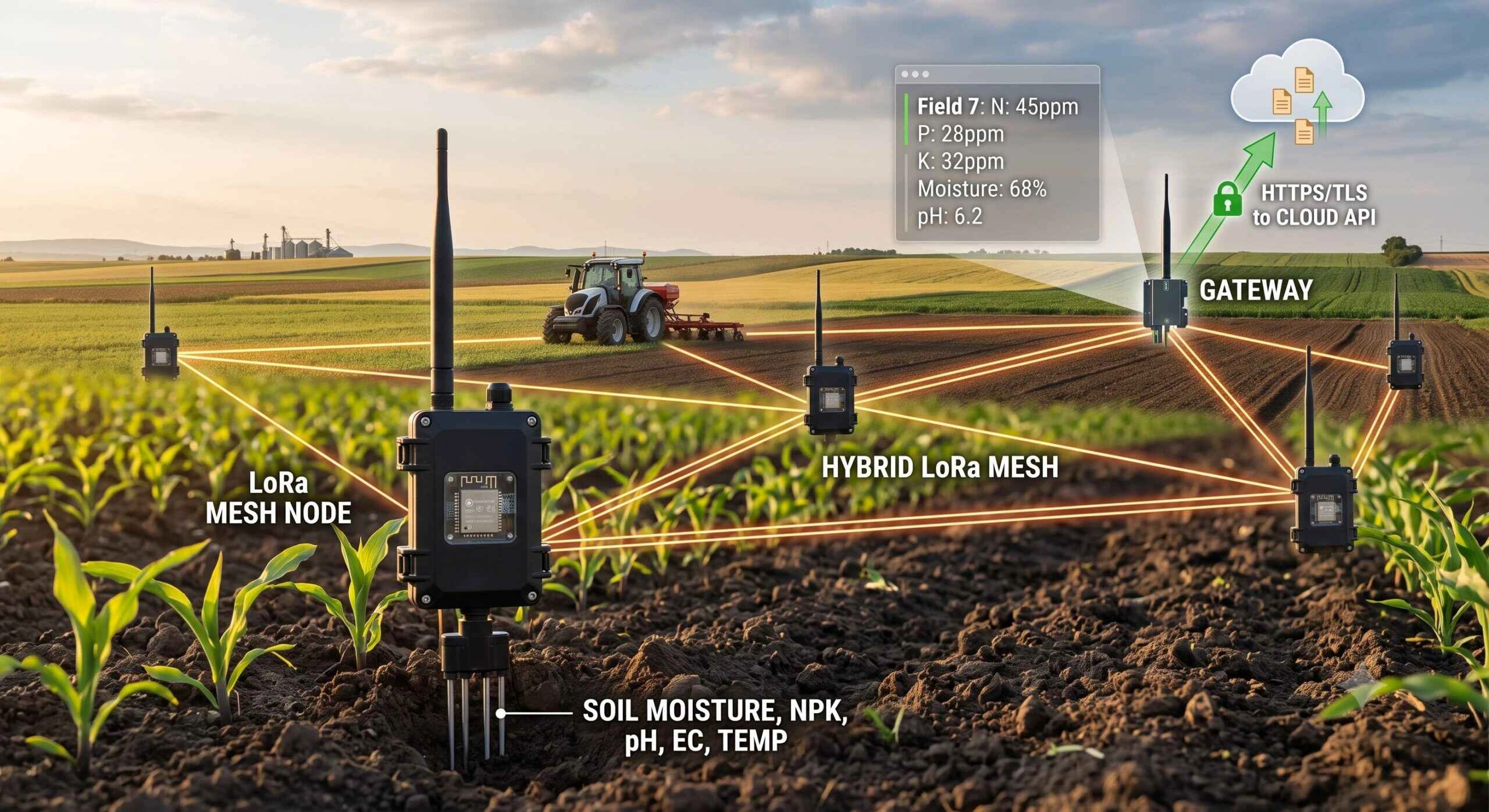
The Engineering Challenge: Farmland Coverage Without Wi-Fi or Mains Power
Precision agriculture depends on continuous, accurate soil data-but field sensor nodes are often spread across sprawling, irregularly shaped farmland with zero Wi-Fi coverage and no electrical grid access. A standard star-topology wireless network fails when tree lines, topography, or distance obstruct direct line-of-sight between field sensors and the central gateway.
- Inability to rely on farm Wi-Fi access points for routine high-frequency telemetry delivery.
- Signal attenuation across large, irregular fields where adding secondary gateway hardware is cost-prohibitive.
- High power consumption of Wi-Fi transceivers draining battery-operated field nodes within days.
Semconix Hardware & Firmware Architecture
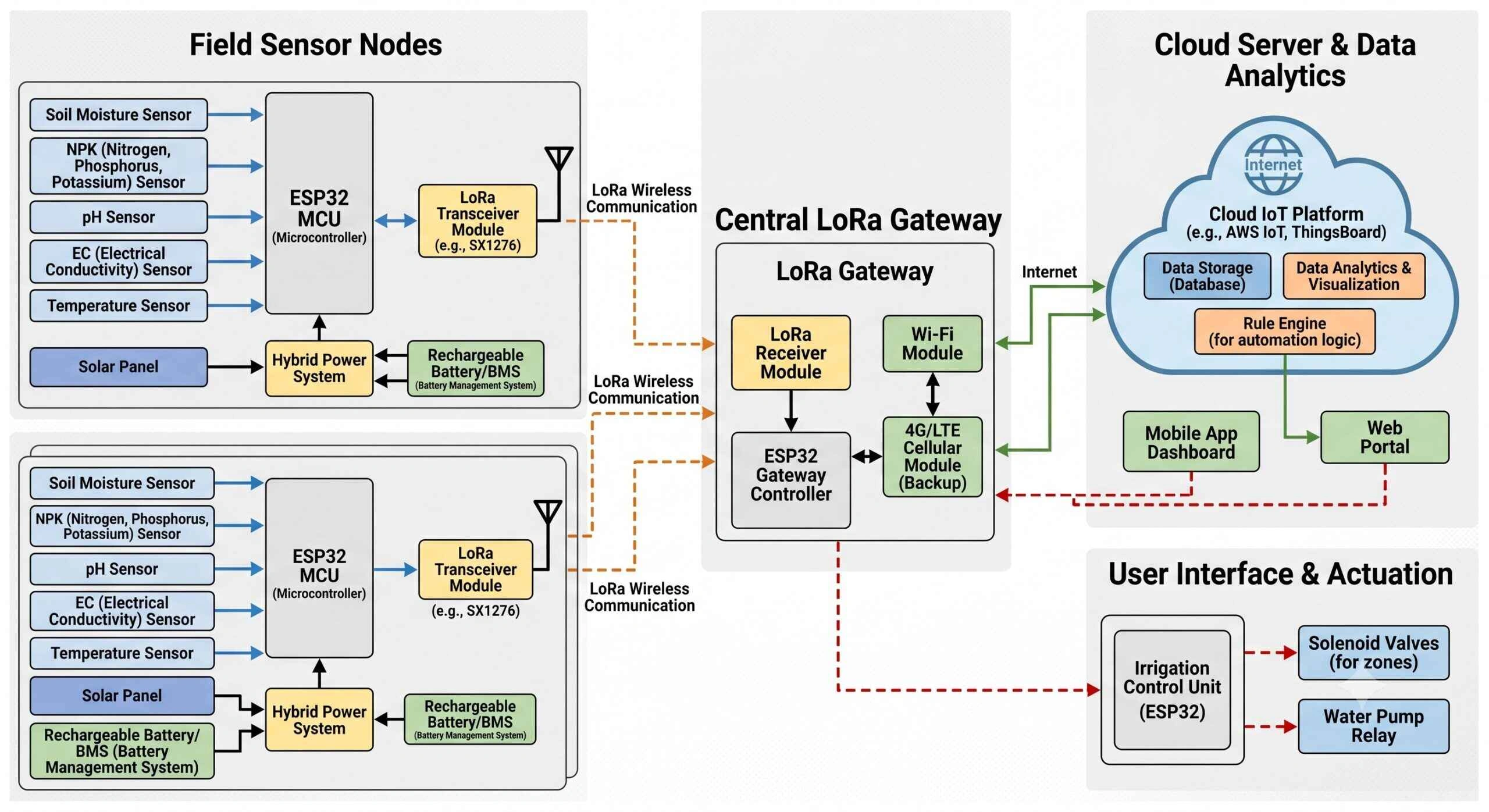
We designed a hybrid wireless topology: sensor nodes attempt a direct LoRa link to the gateway first, and automatically fall back to relaying through a neighboring node when out of direct range...
Field Execution & Commercial ROI
The hybrid LoRa mesh network provided unbroken agricultural telemetry across irregular farmland, enabling growers to automate irrigation triggers and optimize fertilizer dosing.
- Eliminated dead zones across 500+ acres of farmland without purchasing or installing supplementary repeater gateways.
- Reduced irrigation water consumption by 34% by triggering automated valves based on real-time soil moisture thresholds.
- Achieved extended field autonomy on rechargeable LiPo batteries by isolating Wi-Fi usage strictly to OTA update windows.
Key Features
Multi-Parameter Soil Sensing
Moisture, NPK, pH, EC, and temperature via analog, RS485/Modbus, and 1-Wire sensor interfaces.
Hybrid LoRa Mesh Network
Direct node-to-gateway links when in range, with node-to-node relay hops when out of range - extending coverage across large fields.
Battery-Only Power
Rechargeable LiPo (USB-C) power system, sized around LoRa's low transmit duty cycle for extended field autonomy.
Secure HTTPS Cloud Integration
The gateway pushes telemetry to a cloud REST API over TLS - a simple, standard integration with no broker infrastructure to maintain.
Wi-Fi Reserved for OTA Only
Node Wi-Fi stays off except during a scheduled OTA update window, removing it as a routine power draw and RF-noise source.
Field-Ready Design
IP65 enclosure guidance and PCB layout practices for RF/analog isolation and outdoor durability.
Engineering Challenges We Solved
Extending network coverage without extra gateways
A pure star topology fails once a field is large or has obstructions between a node and the gateway. We designed a hybrid topology instead: nodes attempt a direct LoRa link first, and fall back to relaying through a neighboring node when out of range - extending effective coverage without added hardware cost per node.
Removing Wi-Fi as a routine power and noise cost
Keeping Wi-Fi associated continuously is expensive in both power and RF noise for a battery-powered device. We scoped Wi-Fi strictly to OTA updates on a scheduled maintenance window, so day-to-day sensing and LoRa transmission never compete with it.
Sizing a battery-only power budget
With no solar assist, the battery has to carry each node through its full service interval alone. We built a per-mode power budget - deep sleep, active sensing, LoRa transmission, and the periodic OTA window - to size the battery around real, modeled current draw.
Technologies Used
Want Similar Reliability for Your Next Hardware Product?
Our senior embedded architects in Gandhinagar can review your PCB schematics, MCU selection, or RF protocol constraints under strict NDA within 48 hours.