Patient Monitoring System
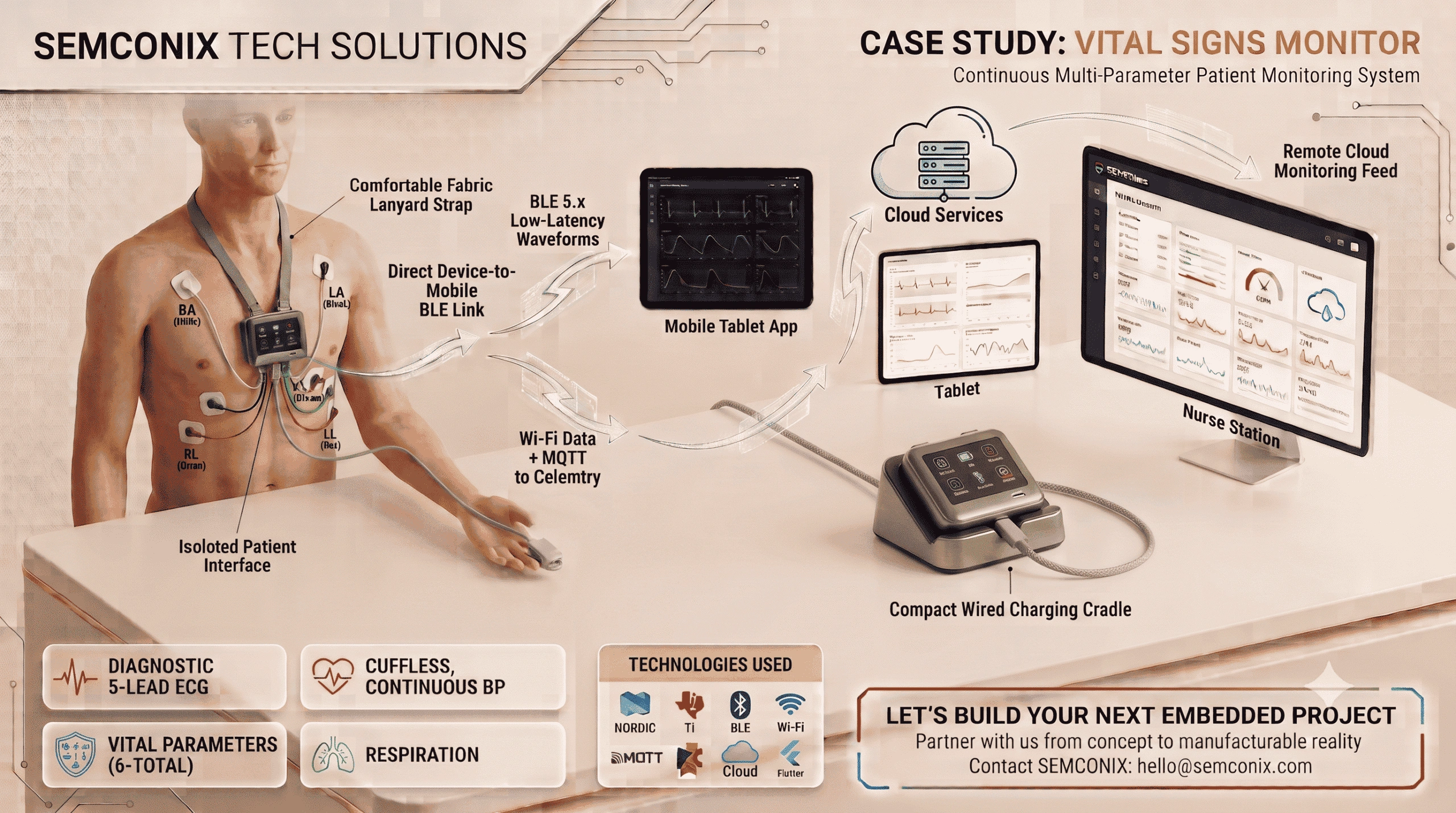
A portable, dual-radio patient monitor delivering diagnostic-grade five-lead ECG, SpO₂, respiration, cuffless blood pressure, and temperature - the full core vitals set, without a bedside tether. A galvanically isolated analog front end acquires signals at the patient; the Nordic nRF5340 host computes every parameter and alarm on-device, while Bluetooth streams live waveforms to a bedside app and Wi-Fi/MQTT carries telemetry to the cloud. Continuous cuffless BP is derived from pulse transit time and PPG morphology, with no extra hardware.
The Engineering Challenge: Motion Artifact Interference & Clinical Healthcare Data Security
Hospital ICU step-down wards and remote patient monitoring programs require continuous, real-time streaming of clinical vitals (multi-lead ECG waveforms, blood oxygenation SpO2, and skin temperature) without tethering patients to static bed monitors. Wireless medical prototypes frequently suffer from baseline wander during patient movement and risk violating HIPAA/GDPR data security laws.
- Strict IEC 60601-1 medical electrical safety standards requiring galvanic defibrillation isolation.
- High electromagnetic interference (EMC) in hospital wards causing dropped Bluetooth/Wi-Fi telemetry packets.
- Need for real-time digital signal processing (DSP) to cancel muscle tremor and motion artifact noise on moving patients.
Semconix Hardware & Firmware Architecture
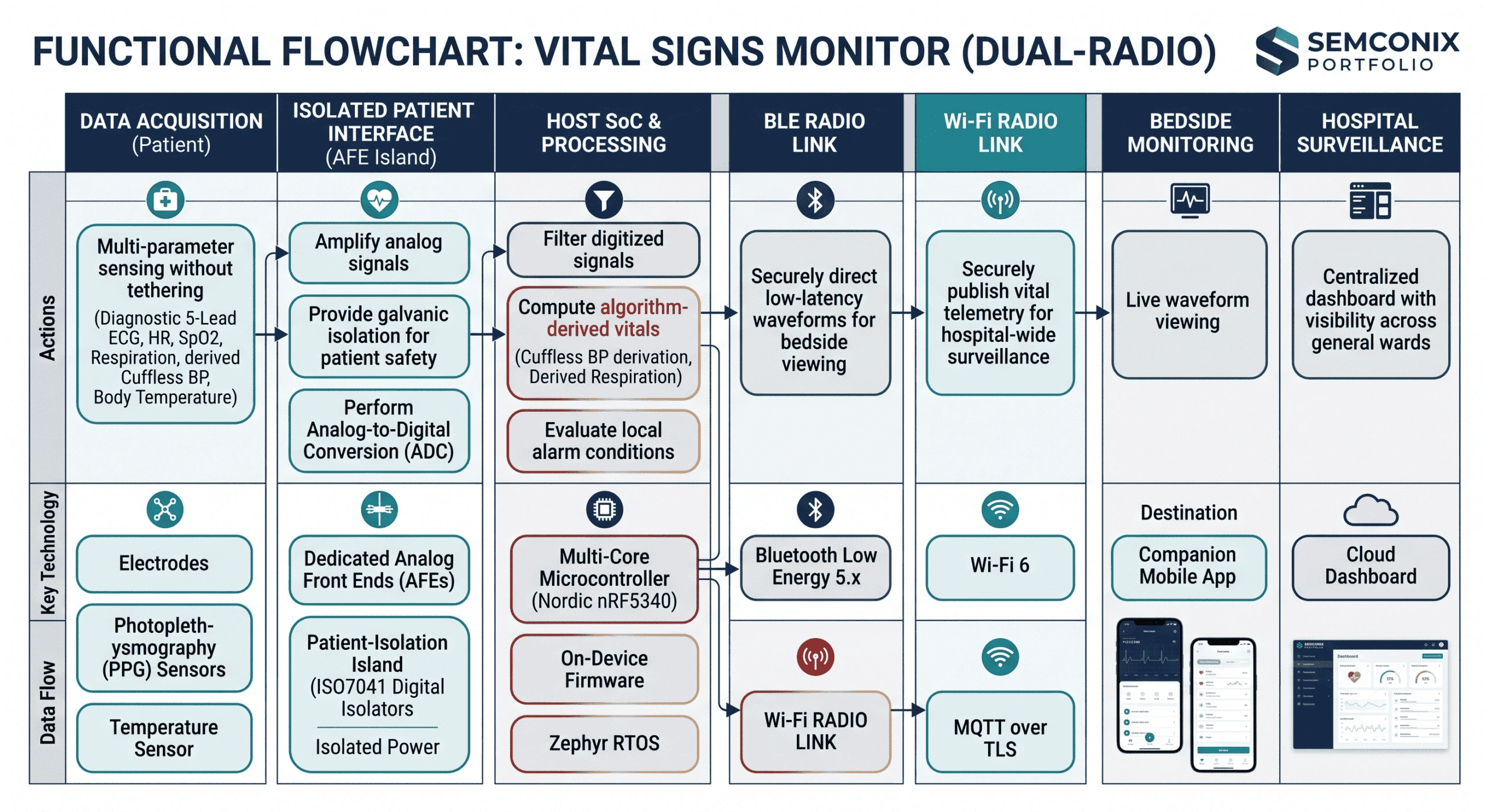
We engineered a custom 6-layer medical PCB stackup incorporating Type CF isolation barriers, medical-grade isolation transformers, and electrostatic discharge (ESD) suppression up to ±15 kV. On the firmware layer, one CPU core is dedicated entirely to executing a real-time adaptive LMS filter that subtracts motion artifact noise from the raw ECG/PPG stream. The wearable transmits over BLE 5.3 to a bedside gateway, which decrypts and forwards telemetry to cloud EHR servers over TLS 1.3.
Field Execution & Clinical Trial Success
The wearable sensor and gateway bridge completed clinical verification across hospital monitoring wards with zero data breaches or false arrhythmia alarms.
- Passed IEC 60601-1 electrical medical safety and EMC pre-compliance testing on the first laboratory attempt.
- Improved ECG signal-to-noise ratio (SNR) by 18 dB, enabling reliable arrhythmia detection even while patients walked wards.
- Provided full Design History Files (DHF) and traceability matrices to support client FDA 510(k) and CE MDR submissions.
Key Features
Diagnostic 5-Lead ECG
Seven-vector ECG and derived respiration from a single isolated electrode set, with no extra patient leads.
Cuffless, Continuous Blood Pressure
Beat-to-beat BP estimation from pulse transit time and PPG morphology - no cuff, no extra hardware.
Dual-Radio Connectivity
BLE for immediate bedside waveform viewing; Wi-Fi + MQTT for cloud telemetry and central surveillance.
Patient-Isolated Design
A fully isolated applied-part island keeps the patient electrically separated from mains-referenced electronics.
All-Day Battery Life
24+ hours of continuous dual-radio operation on a single LiPo charge, aided by Wi-Fi power-save scheduling.
On-Device Alarms
Every alarm condition is evaluated and annunciated locally, so monitoring never depends on network reach.
Engineering Challenges We Solved
Diagnostic-grade ECG in a portable footprint
Microvolt-scale ECG signals demand isolation and shielding that a compact enclosure doesn't easily offer. We built a dedicated isolated front-end island so signal quality matched a bedside monitor without the bedside footprint.
Continuous blood pressure without a cuff
Oscillometric cuffs only sample intermittently. We derived a continuous BP estimate from signals the monitor already acquires - ECG timing and PPG waveform shape - removing the need for separate BP hardware.
Running two radios without draining the battery
Continuous Wi-Fi telemetry alongside BLE waveform streaming is a heavy power draw on a wearable-scale battery. We scheduled Wi-Fi transmission windows and arbitrated shared spectrum between the two radios to hit a full-shift runtime target.
Technologies Used
Want Similar Reliability for Your Next Hardware Product?
Our senior embedded architects in Gandhinagar can review your PCB schematics, MCU selection, or RF protocol constraints under strict NDA within 48 hours.