

Smart Farming IoT – Soil Monitoring & Automation System
An ESP32-based embedded IoT solution for real-time soil and crop-environment monitoring, connected over a hybrid LoRa mesh network for long-range, low-power field deployment.
Project Overview
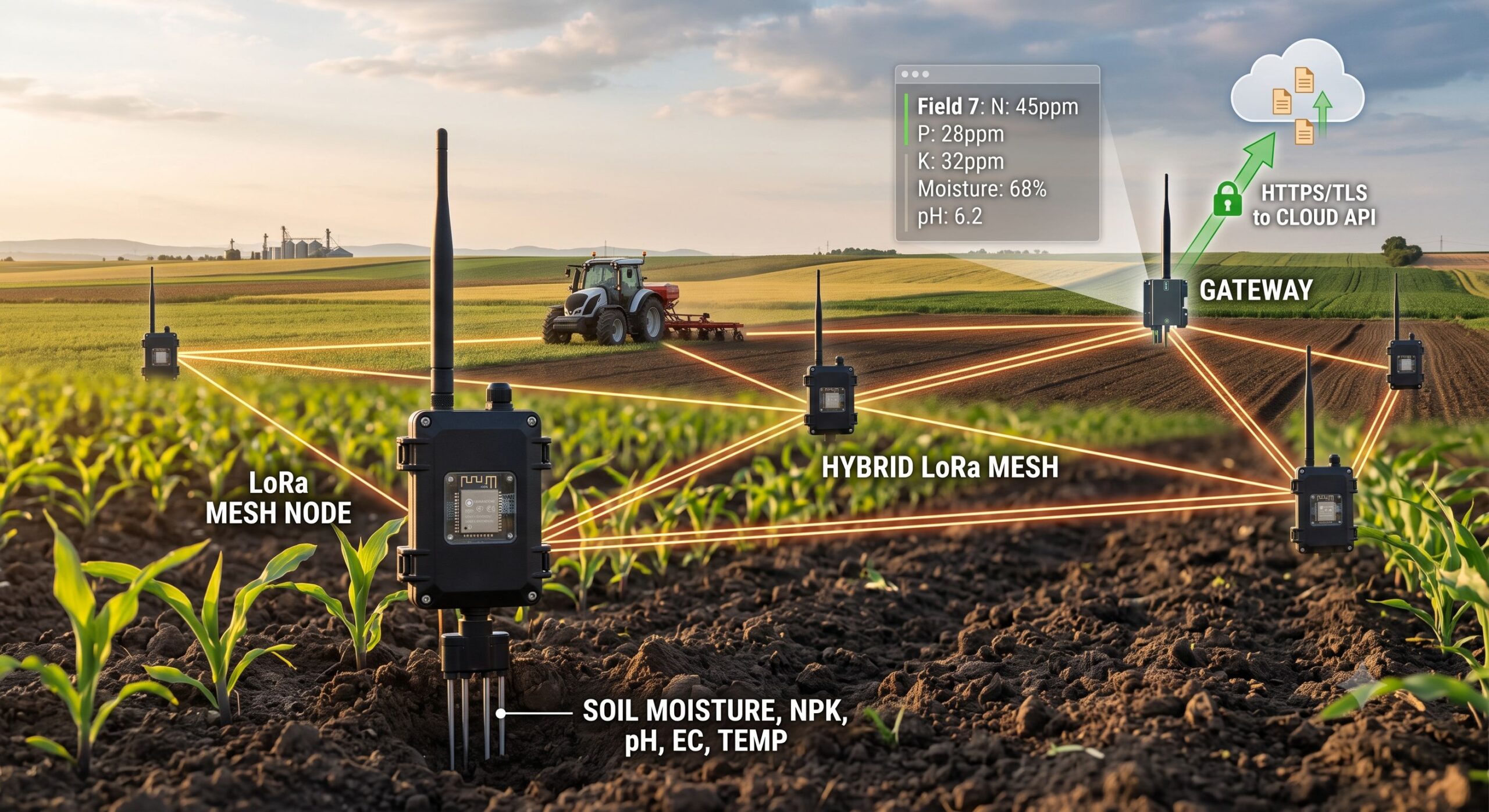
Smart Farming IoT is a field sensor network designed to give growers continuous, real-time visibility into soil and crop-environment conditions — without depending on farm Wi-Fi coverage or mains power. Each battery-powered sensor node measures soil moisture, NPK (nitrogen-phosphorus-potassium), pH, electrical conductivity, and temperature, along with ambient environmental conditions.
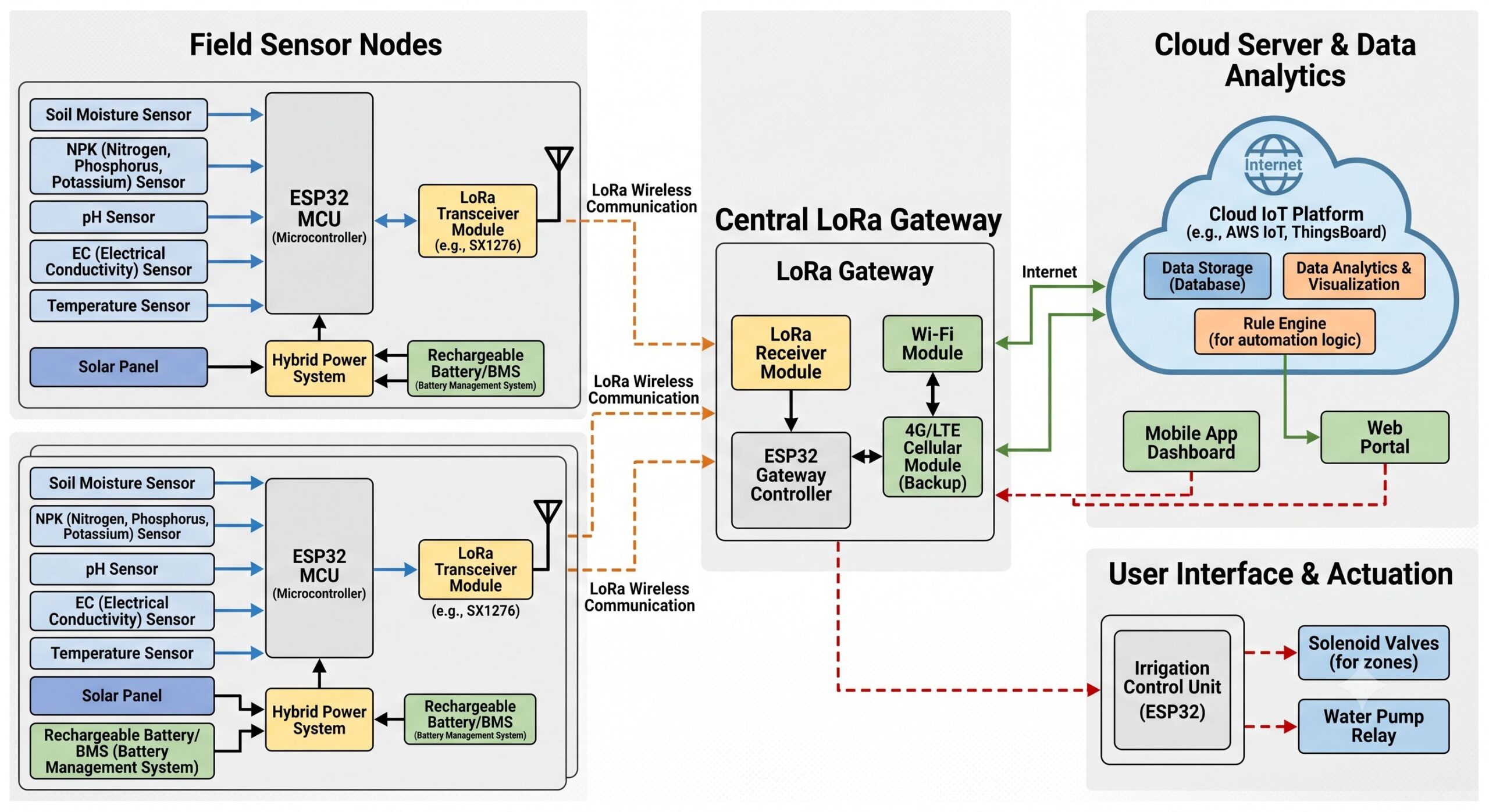
Sensor nodes communicate over a hybrid LoRa network: relaying data node-to-node when needed, and node-to-gateway directly when in range. A gateway aggregates traffic from the network and forwards it to a cloud dashboard over a secure HTTPS connection, giving growers real-time visibility into field conditions and an optional automated irrigation trigger.
The Challenge
Precision agriculture depends on continuous, accurate soil data — but field sensor nodes are often spread across areas with no Wi-Fi coverage and no mains power. The core engineering challenge was building a network that extends coverage across a large or irregularly shaped field using only battery-powered nodes, without depending on a Wi-Fi access point for routine data delivery, while keeping a simple, secure integration path for the cloud backend and firmware maintenance.
System Architecture
Each sensor node sends data over LoRa — either directly to the gateway, or via a neighboring node acting as a relay when it’s out of direct range. The gateway aggregates traffic from all nodes and forwards it to the cloud over HTTPS. Wi-Fi on each node stays powered down except during a scheduled OTA firmware-update window, so it never competes with LoRa timing or drains the battery during normal operation.
Key Features
Multi-Parameter Soil Sensing
Moisture, NPK, pH, EC, and temperature via analog, RS485/Modbus, and 1-Wire sensor interfaces.
Hybrid LoRa Mesh Network
Direct node-to-gateway links when in range, with node-to-node relay hops when out of range — extending coverage across large fields.
Battery-Only Power
Rechargeable LiPo (USB-C) power system, sized around LoRa’s low transmit duty cycle for extended field autonomy.
Secure HTTPS Cloud Integration
The gateway pushes telemetry to a cloud REST API over TLS — a simple, standard integration with no broker infrastructure to maintain.
Wi-Fi Reserved for OTA Only
Node Wi-Fi stays off except during a scheduled OTA update window, removing it as a routine power draw and RF-noise source.
Field-Ready Design
IP65 enclosure guidance and PCB layout practices for RF/analog isolation and outdoor durability.
Engineering Challenges We Solved
Extending network coverage without extra gateways
A pure star topology fails once a field is large or has obstructions between a node and the gateway. We designed a hybrid topology instead: nodes attempt a direct LoRa link first, and fall back to relaying through a neighboring node when out of range — extending effective coverage without added hardware cost per node.
Removing Wi-Fi as a routine power and noise cost
Keeping Wi-Fi associated continuously is expensive in both power and RF noise for a battery-powered device. We scoped Wi-Fi strictly to OTA updates on a scheduled maintenance window, so day-to-day sensing and LoRa transmission never compete with it.
Sizing a battery-only power budget
With no solar assist, the battery has to carry each node through its full service interval alone. We built a per-mode power budget — deep sleep, active sensing, LoRa transmission, and the periodic OTA window — to size the battery around real, modeled current draw.
Technologies Used
Let’s Build Your Next Embedded Project
Partner with us to take your hardware and firmware projects from a rough concept to a manufacturable reality.
Start Your ProjectOr email us directly at: hello@semconix.com